

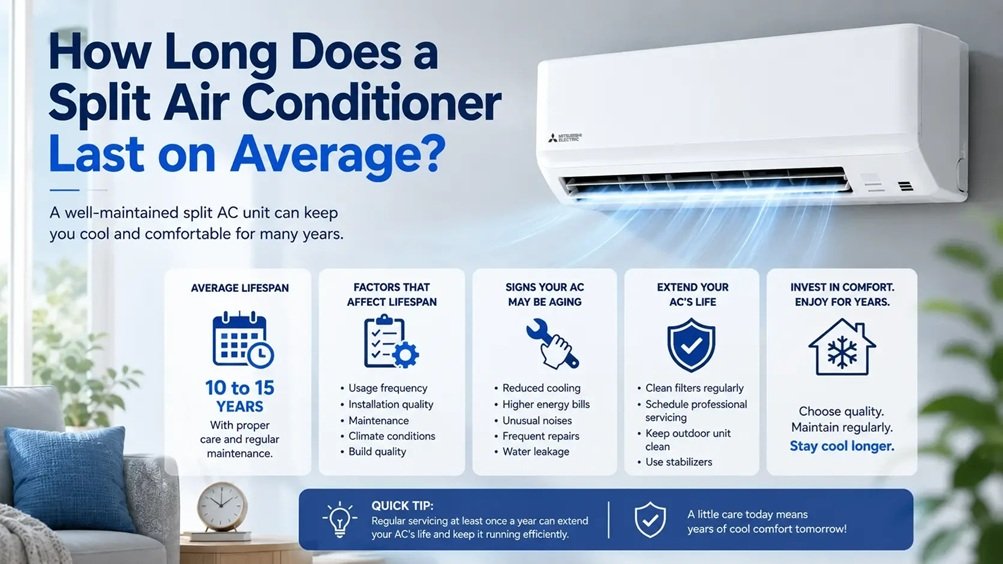
Most people think that an AC’s life expectancy is more than a decade. Some units last that long; others stop working around 5-8 years. While they think the brand is a factor, it is rarely the cause. The air conditioner’s lifespan depends more on how you handle it, where you place it, and how you maintain it. Whether you buy or rent an air conditioner, maintaining the air conditioner is critical. To understand how long the AC will last, you should first know what shortens its lifespan. Here, we will discuss the average air conditioner lifespan, whether skipping AC maintenance saves money, and more.
How Long Should a Split AC Last?
A split AC should give you at least 10 years under normal use. The average life of split air conditioner units is longer than most people expect, because the compressor sits outside. That design also means the outdoor unit takes the brunt of the weather.
Another thing is that the same model survives 15 years in a shared bedroom in Bangalore. But it runs half its lifespan on a sunny terrace in Jaipur. The better question is not the lifespan of an AC unit, but where you keep it.
Lifespan of an Inverter AC vs Non-Inverter AC
An inverter AC may last longer than a non-inverter AC. A non-inverter AC switches the compressor fully on and fully off, again and again, to maintain room temperature. Each hard start adds wear. An inverter AC slows the compressor down instead of stopping it, so it runs more smoothly. Onida puts inverter compressor life at 12 to 20 years with proper care, against 8 to 12 years for non-inverter models.
| AC type or condition | Typical compressor life |
| Split AC, average conditions | 10 to 15 years |
| Inverter split AC, with proper care | 12 to 20 years |
| Non-inverter split AC | 8 to 12 years |
| Harsh conditions, poor servicing | 5 to 8 years |
What is the AC Compressor Life Expectancy?
In practice, AC compressor life expectancy is the life of the whole machine. That is why AC life expectancy and compressor health are essentially the same. You can replace fans, capacitors and remote sensors, but the compressor is an expensive part. If the compressor runs hard, expect the AC’s lifespan to be cut short.
How Many Years Does AC Gas Last?
In a perfectly sealed system, AC gas should last as long as the unit. The gas doesn’t burn up like fuel. It simply moves in a loop. But you may see small leaks – this is common. The India Cooling Action Plan notes that refrigerant gases leak out of AC systems and must be refilled for the system to perform well. If your AC needs a top-up every season, that is a sign of a leak, not normal use. A unit that keeps running low on gas makes the compressor work harder.
What Shortens Air Conditioner Lifespan?
A few things reduce an air conditioner’s lifespan more than anything else. None of them is uncommon in Indian homes, and you can reduce most of them once you know what to look for.
1. Extreme Heat
Yes. On very hot days, the outdoor unit has to push heat into already hot air. Outdoor temperatures above 45°C, common in Rajasthan and Delhi, can push compressor pressure above safe limits. An outdoor unit placed in direct afternoon sun, or boxed into a tight ledge with no airflow, faces this stress for more hours each day.
2. Dusty and Dirty Filters
Dust is the quiet killer of AC unit life. Clogged filters choke airflow over the indoor coil. Dirty outdoor coils trap heat. In both cases, the compressor runs longer to do the same job. Homes near construction sites or busy roads need cleaning far more often than the usual once-a-season routine.
3. Salty Coastal Air
Salt in the air eats into metal. In cities like Mumbai, Chennai, and Kochi, the outdoor coil and its fins corrode faster than they would inland. Corrosion creates pinhole leaks, and leaks mean lost gas. The lifespan of split AC units in coastal homes depends a lot on coil material. Copper coils resist corrosion better than aluminium ones, and anti-corrosion coatings help further.
5. Voltage Fluctuations
They can. Power dips and surges stress the compressor motor and the capacitor that starts it. This is most common in peak summer, when the grid is under load. A good stabiliser, or an AC with a wide built-in voltage range, protects both parts.
6. Moving and Reinstalling
Each move carries some risk. The gas has to be pumped down and held in the outdoor unit. Technicians cut or bend the copper pipes. Then the unit is fixed to a new wall with new joints. A careless job can leave small leaks, a poor drain slope or an outdoor unit with no space to breathe. People who move homes often tend to see this wear build up over the years.
| What shortens AC life | What it wears out | What helps |
| Extreme outdoor heat | Compressor | Shade and clear airflow around the outdoor unit |
| Dust and blocked filters | Compressor, indoor coil | Regular filter and coil cleaning |
| Salty coastal air | Outdoor coil, gas lines | Copper coils, anti-corrosion coating |
| Voltage fluctuations | Compressor motor, capacitor | Stabiliser or wide-voltage AC |
| Poor reinstallation after a move | Gas lines, joints, drainage | Trained technician, leak test after installation |
| Skipped servicing | Whole system | Service before and after peak season |
Can an Air Conditioner’s Lifespan be Increased?
Most AC repairs are fixable. Here are a few small habits you can develop to increase the life expectancy of your AC unit.
1. Clean the AC filter every 2-3 weeks during peak summer.
2. Book a full AC servicing before summer to check the coils and gas pressure.
3. Keep space around the outdoor AC unit open for airflow.
4. Run the AC at 24°C instead of 18°C to reduce the load.
5. Use a stabiliser if the power supply is unstable.
What Does the AC Life Expectancy Mean for Buyers?
Buying an air conditioner makes sense if you plan to stay in the same place for at least 10 years. However, urban residents often live on 11-month leases. Moving means a new room size and a new installation. For them, an air conditioner’s average life expectancy may differ from that of others. If you want to stay in a home for years, buying makes more sense – as long as the AC servicing takes place on time.
Appliance rental platforms, such as Rentomojo, include maintenance and repairs in the plan. They also cover relocation, reducing the risk of damage during transit.
Final Thoughts
In the end, it comes down to how you handle the air conditioner. Maintaining its lifespan is not difficult; you need to make small lifestyle changes. With proper care, an air conditioner can run for a decade. Your settings determine how long it lasts. Unstable power, heat, salt, and poor installation can affect the AC’s life expectancy. Plus, skipping maintenance won’t save you money in the long run. Knowing where you will put up the AC is also another way to figure out what to expect from it.
